Vehicle Emissions
Our vehicle emissions research is focused on understanding the real-world emissions performance of vehicles using a wide range of measurement approaches — including crossroad remote sensing, fast-response continuous point sampling close to roads, and mobile measurements. The overarching aim is to produce robust, measurement-based evidence that can inform emission inventories, air quality policy, and vehicle regulation.
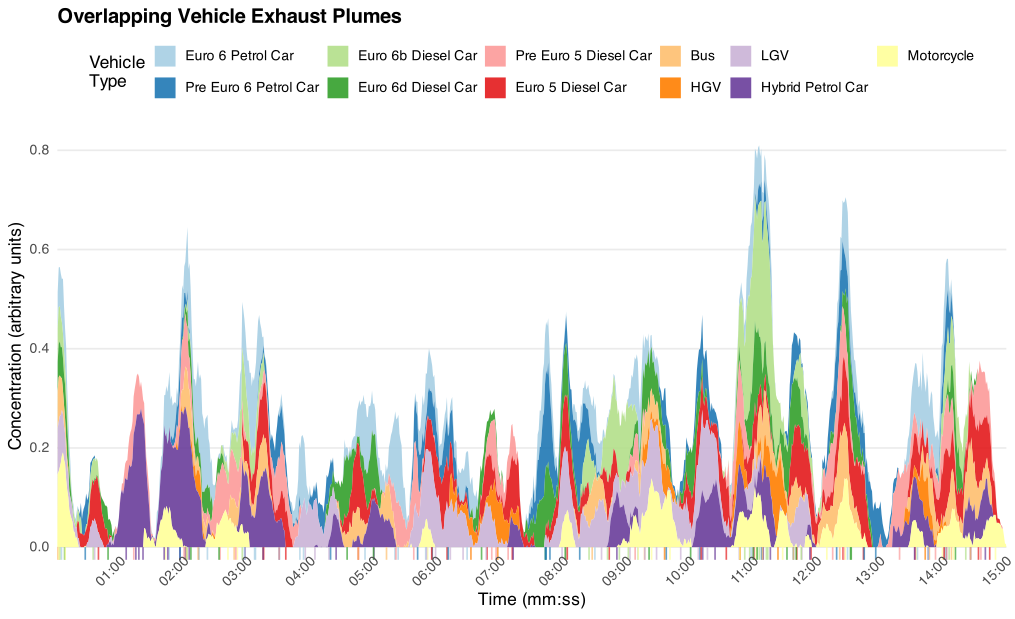
More recently, we have developed a new technique called plume regression (Farren et al., 2024), which uses fast-response instruments at the roadside to quantify vehicle emissions and provide direct concentration source apportionment. The technique overcomes a fundamental complexity of roadside measurements by deconvoluting the overlapping contributions of dispersing vehicle plumes, opening up new possibilities for high-throughput emission characterisation without the need for crossroad beam geometry.
Research highlights
Tailpipe position and near-road air quality — Wilson et al. (2025) quantified how vehicle design, and in particular exhaust tailpipe location, affects near-road concentrations of traffic-related air pollutants. The work received coverage in The Guardian.
Road vehicle ammonia — Farren et al. (2020) used complementary top-down and bottom-up methods to quantify UK total road vehicle NH3 emissions, demonstrating that the national inventory substantially under-estimates emissions from this source.
The European NO2 problem — Carslaw et al. (2011) used extensive remote sensing measurements to show that NOx emissions from light-duty diesel vehicles were not decreasing as expected. Combined with rising primary NO2 emissions (Carslaw, 2005), these two effects produced widespread roadside exceedances of the NO2 limit value across Europe.
Temperature dependence of diesel NOx — Grange et al. (2019) demonstrated a strong ambient temperature dependence in light-duty diesel NOx emissions across measurement campaigns in 2017–2018, with important implications for emission inventories that assume constant emission factors regardless of temperature.
First UK measurements of direct NO2 — Carslaw and Rhys-Tyler (2013) made the first remote sensing measurements of direct NO2 emissions in London, revealing large variability in aftertreatment performance across the vehicle fleet.
Measurement approaches
Remote sensing
Crossroad remote sensing measures the emission ratios of individual vehicles as they pass through an infrared or ultraviolet beam. We have used instruments capable of simultaneously measuring NOx, NO2, NH3, hydrocarbons, and CO2, enabling fleet-scale characterisation across hundreds of thousands of vehicles.
Plume regression
Our plume regression technique (Farren et al., 2024) uses roadside fast-response instruments combined with statistical deconvolution to attribute measured concentration enhancements to individual vehicles. It provides both emission quantification and direct source apportionment without requiring crossroad beam geometry.
Collaborations — current and past
WSP — extensive collaborative measurement campaigns using the Opus RSD5000 instrument, point sampling and plume chase.
The University of Denver — where vehicle emission remote sensing was pioneered by the late Professor Donald Stedman and Dr Gary Bishop.
OPUS RSE — based in Madrid, developers of the RSD5000. The University of York owns an RSD5000 instrument.
The CONOX partnership — which led to the creation of Europe’s first vehicle emission remote sensing database.